“GLOBAL IT SERVICES FOR A GLOBAL BUSINESS”
The objective of the engagement was to design and sustainably implement a global IT operating model. The focus was on consistently delivering global IT services, establishing clearly defined global IT service ownership and enabling efficient, reliable 24/7 service delivery through regionally distributed teams.




Initial Situation
Our client, a global manufacturer of warehouse automation and intralogistics solutions, operates a portfolio of strong, independent brands across multiple regions.
As part of its international harmonisation initiative, core business processes were restructured and aligned globally. This transformation directly impacted the IT organisation responsible for delivering these processes. Previously regionally organised IT units were no longer able to support globally standardised business operations efficiently. The challenge was to design and implement a global IT operating model that aligns IT services with global business processes while integrating regional organisations into a single, unified IT function.

Objectives
- Definition of the structural and operational setup of the global IT organisation
- Design of best‑practice approaches for scalable global IT services
- Development and delivery of targeted training programmes for managers within the new IT organisation
- Execution of change, transition and communication activities across employees, processes and systems
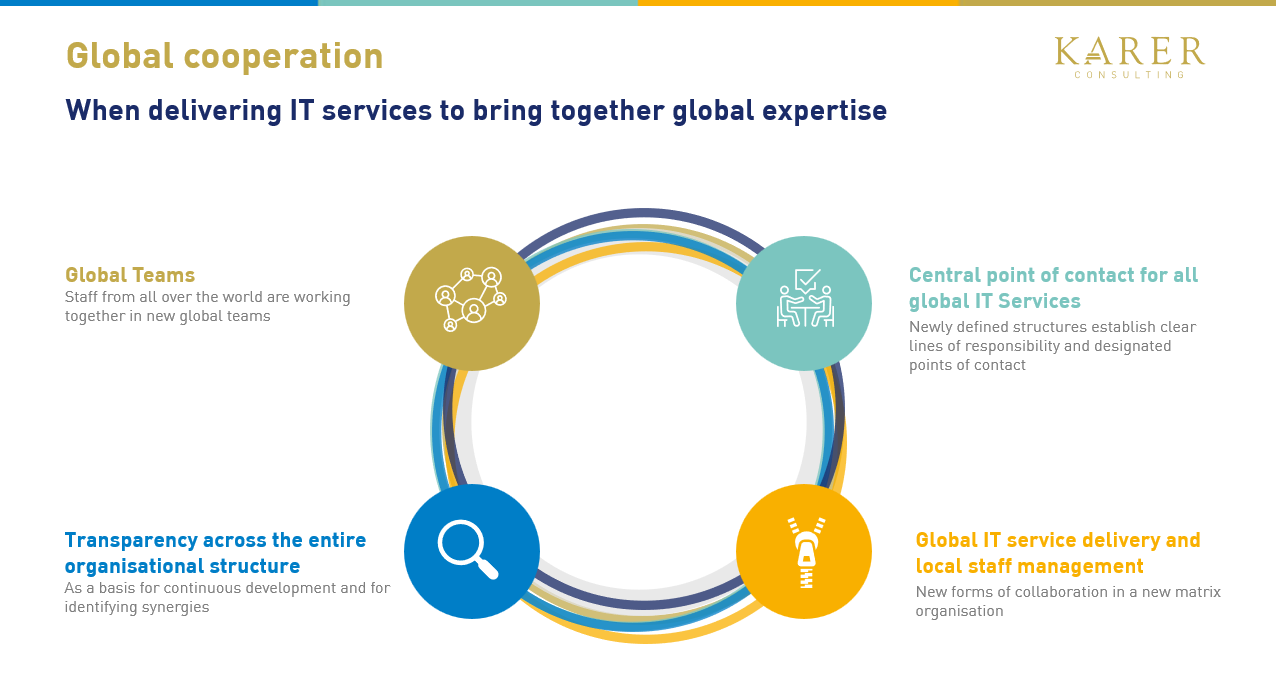
- Design and sustainable implementation of a global IT operating modelBest practice solutions for the design of global IT services
- Consistent delivery of global IT services with globally accountable service owners
- Delivery of targeted training programmes to ensure understanding of the new IT organisation
- Management and planning of the transition at the employee, process and system levels
KC Process Model
During the design phase, the strategic foundation of the global IT operating model was defined. Based on required organisational capabilities, roles, processes and collaboration models were designed using proven best‑practice approaches and tailored to the client’s objectives. This ensured clear responsibilities from the outset.
Co‑creation and organisational change management (OCM) were critical success factors to actively support employees throughout the transformation and address resistance early.
In the nomination phase, the organisation was further developed in close collaboration with managers, employees and key stakeholders. The IT service portfolio played a central role in shaping the target organisational structure.
The defined service portfolio ensured clear ownership, improved communication across core ITSM processes and supported efficient service delivery and continuous improvement.
With go‑live, the new organisational structure became operational. Structured transition management and targeted training for new and changed roles ensured sustainable implementation of the global IT operating model.
The result was a fully operational global IT organisation with clearly defined responsibilities and reliable 24/7 IT service delivery for global business processes.




Stefan Paule
Telephone: +49 751 185 275 0
E-Mail: sales@karer-consulting.com
www.karer-consulting.com