


In the context of a modern target operating model, the product-oriented focus of IT is becoming increasingly important. Product-based IT describes an organisational approach in which IT services are no longer structured and provided based on required services, but as integrated services focussed on business products along business value streams.
This way of thinking enables closer integration of IT and business, promotes agile collaboration and creates the basis for fast, stable and transparent service delivery.
Traditional IT organisations often follow the ‘plan-build-run’ model, which is characterised by functional silos. In times of digital transformation, however, this model is reaching its limits: the demands for speed, flexibility and business proximity are constantly increasing.
Product-based IT addresses this issue and creates a structure that is oriented towards the actual value streams and business processes of the company and the products it produces. IT teams are organised along these value streams and take responsibility for the development, operation and continuous improvement of their products. Also, this allows a service-oriented IT organisation to be further developed and improved building on established services and teams.

Product-oriented IT is characterised by the following elements:
- Matrix organisation along value streams: IT teams are cross-functional and work closely with the specialist departments.
- Clear roles and responsibilities: Roles such as product owner, solution architect and team coach are central to management and implementation.
- Agile working methods and DevOps: Iterative development and structured work with Kanban are integral components, enabling a transition to continuous integration and automated deployment (CI/CD).
- Transparent governance and control: Decisions are made where the relevant information is available – supported by lean portfolio management.
- Integration of classic ITSM processes: ITIL-based processes continue to be used and are thus integrated into the agile structure.
Product-based IT is not an isolated approach, but part of a comprehensive target operating model that takes into account all relevant dimensions of a modern IT organisation – from strategy and governance to processes and architecture to skills and culture.
With Karer Consulting, you can make your IT fit for the future: business-oriented, agile and successful.
As part of our holistic IT transformation consulting services, we support organisations in the introduction and scaling of product-based IT. Our structured approach covers all relevant phases:
1. Design – Strategic alignment and organisational architecture
Together with your IT management, we develop a product- and value stream-based organisational model. Based on best practices, we work with you to define roles, processes and governance structures and integrate them into your existing IT landscape.
2. Nomination – Filling the structure with life
We support you in filling the new roles and teams. Accompanied by change management, the structure of the organisation is developed carefully and promptly.
3. Transition – Task handover and role integration
In this phase, we accompany the adaptation and handover of existing tasks so that they fit the new structure for everyone. We conduct role training and ensure that employees can take on their new roles not only formally, but also in terms of content.
4. GoLive & Scaling
After the successful launch of the first product IT clusters, we support the scaling to other areas. Through continuous monitoring and feedback, we ensure the sustainable anchoring of the new model – also considering international management and setup of your IT organisation.

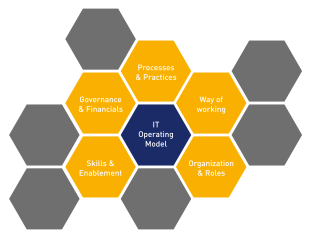
Product-based IT is embedded in a holistic target operating model and takes key strategic dimensions into account:
- Organisation & Roles: Matrix organisation along value streams with clear role profiles
- Way of Working: Introduction of agile methods and DevOps practices
- Processes & Practices: Integration of classic ITSM processes into agile structures
- Governance & Financials: Lean portfolio management and transparent decision-making processes
- Skills & Enablement: Training and development of employees for new roles and ways of working

Stefan Paule
Telephone: +49 751 185 275 0
E-Mail: sales@karer-consulting.com
www.karer-consulting.com