


An IT operating model or Target Operating Model (TOM) is a blueprint for how an organisation organises its resources, processes and governance structures in order to provide sustainable added value to its customers and stakeholders. In the context of IT management, the IT operating model serves as a strategic guide for how IT is provided, managed and supported.
A well-defined TOM creates clarity about responsibilities, improves collaboration between business and IT, and enables an agile, scalable and future-proof organisation.


Our approach
The Karer Consulting TOM approach
Together with our clients, we pursue a structured and practice-oriented approach to develop a tailor-made Target Operating Model. Our approach comprises four key phases:
- Defining strategic guidelines and dimensions
We analyse your business strategy and derive the goals and relevant dimensions for your future operating model.
- Developing principles and high-level structure
Together with your IT management, we define the basic principles and overall structure of your TOM.
- Detailing processes, roles and artefacts
In workshops, we develop concrete processes, role profiles and governance structures.
- Implementation with change and transition management
We support you during implementation – with a focus on communication, acceptance and sustainable change.
We work closely with your IT management and integrate your business and IT strategy into the entire process.

A modern IT operating model
Dimensions
A future-proof TOM takes ten strategic dimensions into account, which we analyse and design together with you. These dimensions form the basis for an efficient, agile and scalable operating model that optimally prepares your IT organisation for the future.
- Business Strategy: Alignment and standardisation of your business processes
- Service Portfolio: Definition and control of your IT services
- Sourcing: Optimisation of the sourcing mix and supplier management
- Way of working: Introduction of agile methods and collaboration frameworks
- Capabilities: Definition and development of the necessary skills and roles for service delivery
- Organisation: Definition of the organisational structure
- Financials: Budget responsibility and billing models
- Governance: Control mechanisms and guidelines
- Collaboration: Processes for internal and external collaboration
- Skills: Qualifications and further development of your employees

Shaping the future
Digital TOM by Karer Consulting
With our Digital Target Operating Model, we combine classic organisational development with the requirements of the digital world. We integrate modern technologies and automated processes into your operating model, thus creating the basis for sustainable digital transformation. By combining different delivery models – from classic to agile, from internal to external sourcing – we will find the right solution for your business!
Our Digital TOM has a modular structure and can be flexibly adapted to your corporate strategy and IT landscape. It supports you in implementing innovations more quickly, optimising costs and positioning your IT as a true business enabler.
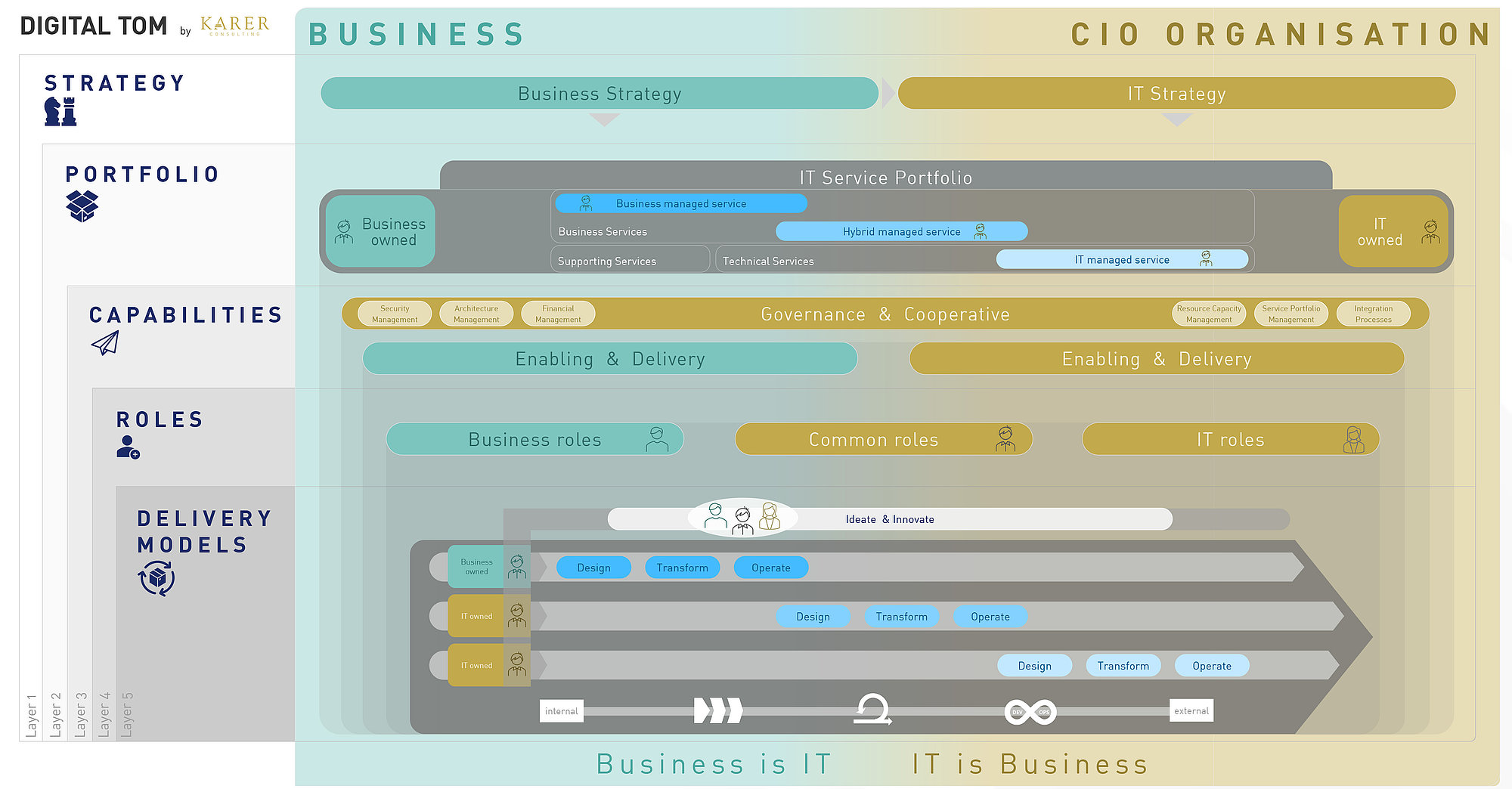
The introduction of a new target operating model (TOM) is a key lever for sustainable organisational development and strategic realignment. We support organisations not only in the design, but through to full implementation – including role allocation, task transfer, training and monitoring. With more than a decade of experience, a structured, proven framework and a team of highly qualified consultants with in-depth expertise in change management, HR processes, works council communication and organisational transformation, we offer the greatest possible implementation strength. Our clients benefit from an integrated approach that takes strategy, structure and people into account in equal measure – ensuring that the new operating model is not only planned, but also lived.

1. Design – Strategic alignment and organisational architecture
Together with the CIO, we define the strategic objectives of the new operating model: Should the organisation operate in a more global, agile, cost-efficient and/or business-oriented manner? Based on these guidelines, we develop key design artefacts such as role models, skill profiles, process architectures, individual process descriptions, governance structures, service portfolios and – as required – sourcing concepts. Our tried-and-tested templates and flexible blueprints enable a tailor-made design, which we develop further together with the organisation's employees. This collaborative approach ensures that the strategy is not only conceived but also anchored in operations.
2. Nomination – filling the structure with life
In this phase, the organisational model is specified and staffed. The structured top-down nomination process, which we actively support, begins with the CIO and continues through all management levels to the teams. Existing employees are integrated into the new structure by their future management team, taking into account their skills and experience. Our skill-based mapping approach ensures that each role is filled optimally – transparently, comprehensibly and in line with the strategy. We coordinate closely with Human Resources (HR) and the works council to take legal and employment contract requirements into account at an early stage. This close involvement of all relevant stakeholders is a key feature of our approach and a decisive factor for success.
3. Transition – handover of tasks and role integration
The transition phase ensures that employees can take on their new roles not only formally, but also in terms of individual tasks. We support the flexible, time-efficient analysis of existing tasks and ensure their compatibility with the new role profiles is determined. Tasks that no longer fit the new roles of the employees are either distributed to employees with suitable roles, eliminated or outsourced, so that the start of the Target Operating Model is successful. This process requires precise handover management and alignment by all affected employees, which we support with clear processes, monitoring mechanisms and reporting. In addition, we conduct role training, process training and system updates as needed to anchor the new structures in the long term. Our ability to manage even complex transitions in a structured and successful manner sets us apart in many ways.
Define the vision
IT Strategy
Together we define your future IT Strategy considering customer-orientation, current and future challenges and trends in IT.
Deriving a strategic roadmap puts the strategy in action.
Define the right target operating model for your IT
Organization Design & Transition
Identify challenges for your IT and derive capabilities needed in future.
Design the structure, functions, roles, organisation and collaboration model of your IT organization accordingly. Manage the transition from the current state to a future state-of-the-art IT organization with our proven transition approach and ensure the defined operating model gets operative and benefits are realized.
Design your end-to-end services
Service Portfolio
Design your service portfolio and individual services, their architecture and dependencies based on our industry-specific best practice blueprints.
Go the road to service-orientation and let services become the driver for your service management.
Assess, optimize, define, design and implement your IT Service Management practices
Practices & Processes
With our deep industry knowledge and extensive experience, we offer a comprehensive range of services and products designed to elevate your IT capabilities and achieve sustainable value for your business customers.
Explore how we together can empower your IT organization to embrace your service management by using best & good practices and achieve operational excellence in the ever-evolving digital landscape.
Ensure governance for IT across the organisation
Integrated IT (Digital-OM)
Establish governance and collaboration for all IT functions within an organisation. Nevertheless, if IT services are owned in business or IT.
Use common governance to establish an increased security level in the whole organisation.
Every IT transformation involves changes for those affected
Organizational Change Management
The key to project success is to recognize and actively manage changes for the individual employees, teams and the entire organization.
With targeted and effective change management measures, your organization emerges from change stronger and more productive.

Stefan Paule
Telephone: +49 751 185 275 0
E-Mail: sales@karer-consulting.com
www.karer-consulting.com